⚡ Quick Read Summary
The 6 things to know about custom mylar bags before placing your first order:
Mylar is a film, not a bag. What's sold as a "mylar bag" is a multi-layer laminate combining BoPET with aluminium foil or metallised PET barrier.
Thickness gauges matter. 3.5 mil for short-shelf retail, 5 mil for premium retail (the standard), 7 mil for long-term storage.
Foil vs metallised PET is a real choice. Foil for shelf-life above 12 months. Metallised PET for 6 to 12 months at lower cost.
MOQ depends on print method. Digital print starts at 1,000 units. Rotogravure starts at 5,000 units per SKU.
Food-grade compliance is not automatic. Verify FDA 21 CFR or EU 10/2011 documentation from the supplier before ordering.
Match spec to product, not prestige. The most common first-order mistake is overspecifying for a premium feel rather than actual product chemistry.
Mylar is not a bag. It is a film. The packaging industry has used the word so loosely for so long that most buyers assume "mylar bag" describes a finished product, but the underlying material is BoPET (biaxially oriented polyethylene terephthalate), originally a DuPont trademark for polyester film developed in the 1950s. What gets sold today as a mylar bag is almost always a multi-layer laminate combining BoPET with aluminium foil or metallised PET, plus a heat-seal inner layer, and sometimes an outer protective layer. The barrier performance comes from the foil or metallisation. The mylar layer gives the structure dimensional stability and printability.
This guide covers what brands ordering custom mylar bags actually need to specify, the thickness gauges that match different product categories, the difference between aluminium foil and metallised PET barrier, what minimum order quantities are realistic in 2026, and the printing and compliance decisions that separate professional procurement from learning the hard way on a first production run.
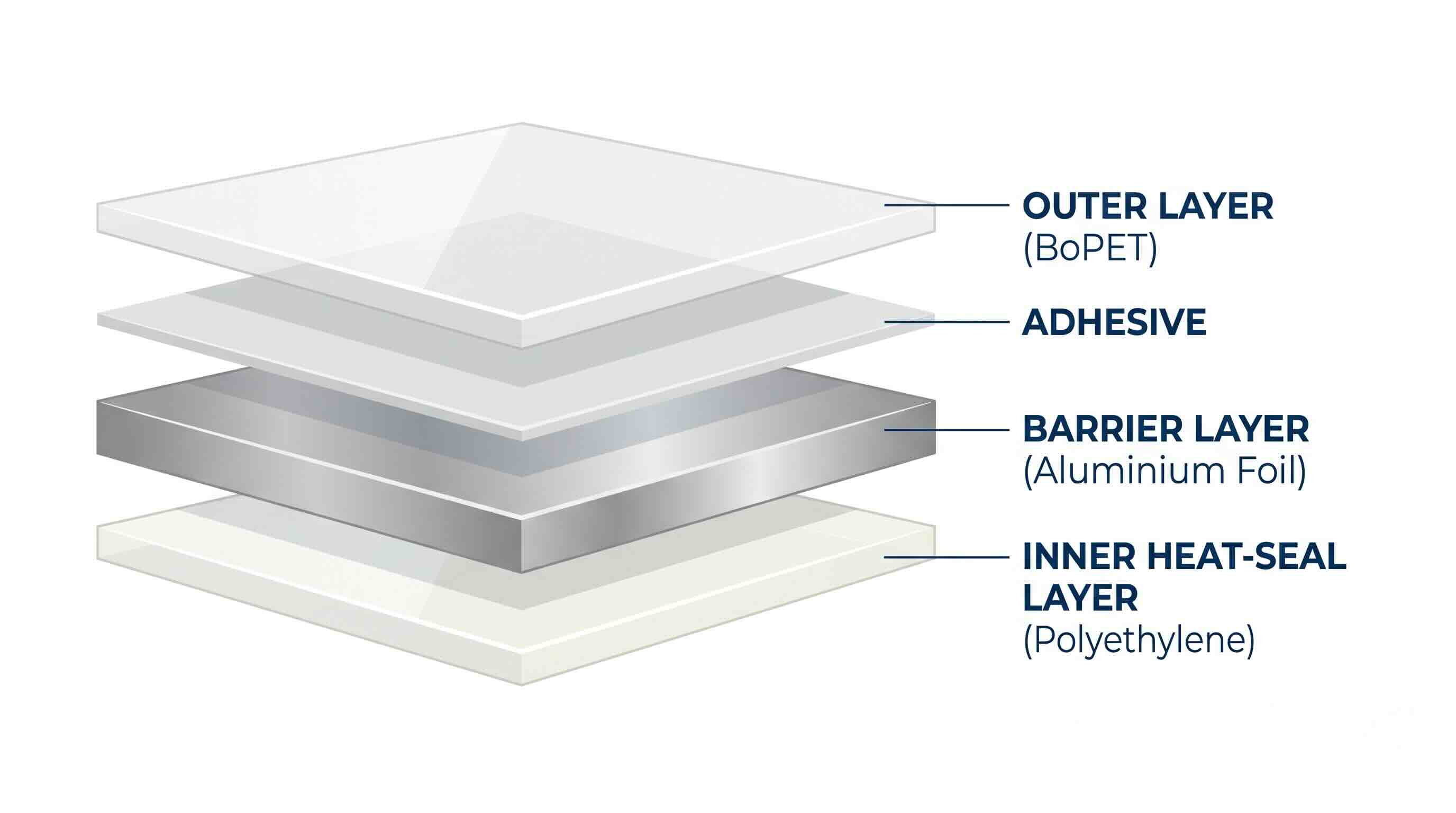
Strip a mylar bag down to its layers and you find three or four films stacked together. The outer film is usually printed BoPET or BoPP for branding and scuff resistance. The middle layer is the workhorse, either aluminium foil at 7 to 9 microns thickness or metallised PET that has been vapour-deposited with a microscopic layer of aluminium. This is where the barrier comes from. The inner layer is heat-seal polyethylene, the part that fuses together when the bag is closed. An adhesive layer sits between each film, bonding the laminate into one structure.
The reason brands ask for mylar specifically is barrier performance. A standard polyethylene bag passes oxygen at roughly 100 to 200 cubic centimetres per square metre per day. A mylar bag with metallised PET barrier drops that number to 0.5 to 2 cc per m² per day. With aluminium foil, oxygen transmission falls below 0.1 cc per m² per day. Light transmission essentially zero. Moisture vapour transmission rate (WVTR) drops to 0.5 g per m² per day or lower. For products that lose freshness or potency on contact with oxygen, light, or moisture, mylar is not a marketing choice. It is the only material that delivers the shelf life retail buyers and consumers expect.
📌 Key Takeaway
Mylar's value is its barrier numbers, not the word "mylar." A real mylar laminate cuts oxygen transmission by 100x to 1000x compared to plain plastic. If a "mylar" bag does not come with verifiable oxygen and moisture transmission data, it is probably plain plastic in better packaging.
Mylar bag thickness is measured in mils (thousandths of an inch) or microns. The most common retail gauges are 3.5 mil, 5 mil, and 7 mil. Each gauge serves a different product category and shelf life target.
3.5 mil (about 90 microns). Entry-level barrier. Good for short-shelf retail products, single-use packaging, sample formats, and lower-risk dry goods. Fine for products with 6 to 12 month shelf life targets where the bag will not face heavy handling or warehouse storage stress. Most cannabis-adjacent and small-format supplement bags sit in this gauge.
5 mil (about 125 microns). The retail standard for premium products. Holds up to repeated handling, multi-channel distribution, and 12 to 24 month shelf life targets. Coffee, premium supplements, dried snacks, freeze-dried protein, and most professional retail mylar bags use this gauge.
7 mil and above (175+ microns). Heavy-duty applications. Long-term food storage, military rations, freeze-dried meals with 25-year shelf life claims, and any product where the bag itself needs to resist puncture during handling. Most consumer products do not need this gauge. Brands that specify it usually do because of distribution requirements, not product chemistry.
Most brands buying mylar bags do not realise there are two completely different barrier technologies hiding behind the word. The choice affects both performance and cost meaningfully, so it is worth getting right.
Aluminium foil barrier uses a continuous metal layer typically 7 to 9 microns thick, sandwiched into the laminate. Foil delivers near-perfect barrier. Oxygen below 0.1 cc per m² per day. Light transmission zero. Moisture barrier excellent. The downsides: foil is more expensive than metallised PET, slightly less flexible, and can crack at fold lines if mishandled. For products with shelf life claims above 12 months and high oxygen sensitivity (coffee, freeze-dried meat, omega-3 supplements, vitamin formulations), foil is the right specification.
Metallised PET uses vapour-deposited aluminium at a microscopic thickness measured in nanometres rather than microns. The visual effect looks similar to foil. The barrier numbers are not. Metallised PET typically delivers oxygen transmission of 0.5 to 2 cc per m² per day depending on the metallisation density, which is excellent compared to plain plastic but an order of magnitude worse than foil. The advantages: lower cost, more flexibility (no fold cracking), and easier laminate construction. For products with 6 to 12 month shelf life targets where the freshness window is shorter, metallised PET is more cost-effective and the barrier is sufficient.
📌 Key Takeaway
Foil for 12+ months. Metallised PET for under 12 months. Pick by your shelf-life target and oxygen sensitivity, not by which sounds more premium. A foil bag for a product with 6-month shelf life is wasted money.
A US supplement brand reached out to us late last year. Founders, small team, launching a powdered greens product after running a Shopify pilot in stock kraft pouches. The pilot worked. Customers ordered. The problem was that the kraft pouches were not retaining freshness past three weeks, and customer reviews started flagging the powder turning clumpy and the colour fading. They knew they needed mylar but did not know what to specify.
Their first instinct was 7 mil aluminium foil with full rotogravure printing. Premium spec, premium look. They had heard from another supplement founder that this was "the gold standard." We pushed back. Their actual order volume was 3,000 units for the first run, scaling to 8,000 to 12,000 units per quarter. Rotogravure setup at that volume does not pay back. Aluminium foil at 7 mil for a product with 12-month shelf life is overspecified. Both decisions would have eaten their margin on the first SKU and locked them into MOQs they could not realistically hit.
What we recommended: 5 mil stand up mylar pouches with metallised PET barrier, digital printing for the first 1,000 units, with the option to switch to rotogravure on reorder once they passed 5,000 units per run. Press-lock zipper with tear notch. Their cost per unit landed roughly 40 percent below the original spec. The product held freshness through their full distribution cycle. Six months in they reordered, scaled volume, and switched to rotogravure on the second run as planned. The spec they ended up with was the spec they needed, not the spec the industry told them was premium.
Minimum order quantity for custom mylar bags is the variable that confuses procurement teams more than any other. The MOQ depends on the printing method, the bag size, the laminate complexity, and the supplier's production minimums. Two numbers to know.
Digital print MOQs at XWPAK start at 1,000 units. Digital print uses no plates, prints directly from a digital file, and runs efficiently at low volumes. The trade-off is per-unit cost is higher than rotogravure at scale. Digital is the right choice for first runs, limited editions, multi-SKU launches with low individual volumes, and brands testing market response before committing to bigger production runs.
Rotogravure MOQs typically start at 5,000 units per SKU and scale efficiently from there. Rotogravure uses engraved cylinders (one per colour, up to 10 colours) which requires plate setup cost and time. The plates pay back at higher volume because the per-unit print cost drops dramatically. For brands shipping above 10,000 units per SKU per quarter, rotogravure is the lower total-cost option. Below that volume, digital is more economical even though per-unit cost is higher.
 | ★ Featured Product Custom Mylar Bags & Stand Up PouchesHigh-barrier laminate, 3.5 to 7 mil gauges. Aluminium foil or metallised PET. FDA & EU 10/2011 compliant. BRCGS certified production. Low MOQ from 1,000 units on digital print. View Product → |
Print finish on mylar bags affects both the visual brand language and how the bag photographs for online retail. Five options matter most.
Matte finish. The current default for premium positioning. Reduces glare in product photography, feels softer in hand, photographs cleaner against any background. Most clean-label, premium supplement, and specialty coffee brands use matte.
Gloss finish. High shine, vibrant colour reproduction. Better for impulse-purchase categories where shelf-pop matters more than premium feel. Snack brands, candy, energy products often choose gloss.
Soft-touch finish. Velvet-like surface texture. Most expensive of the standard finishes. Used by prestige supplement brands and cosmetics-adjacent products where the in-hand feel signals premium quality at the same price point as glass packaging.
Spot UV. Selective glossy coating applied over specific design elements (logo, brand name, product photography) on an otherwise matte bag. Adds visual depth and tactile contrast. Common on premium specialty coffee bags where the brand name needs to stand out.
Foil stamping and embossing. Metallic foil hot-stamped onto the bag for logos or accent details. Embossing creates raised or recessed texture in the bag surface. Both add cost. Both deliver an unmistakable premium signal that justifies retail price points above $30 to $40 per unit.
Coffee. The combination of high oxygen sensitivity, premium retail positioning, and consumer expectation of barrier performance makes mylar the dominant material in specialty coffee. Add a one-way degassing valve to handle CO2 release from freshly roasted beans and the format is complete.
Supplements and nutraceuticals. Probiotics, omega-3, vitamin formulations, powdered greens, protein powders, and adaptogen blends all degrade quickly without barrier protection. Mylar is the standard for shelf-stable supplement packaging, with foil-grade barrier for products with active ingredients that fail under oxidation.
Regulated products. Mylar's barrier and printability work well for products requiring child-resistant closures, specific compliance labelling, or smell-proof packaging. Brands operating in regulated categories rely on mylar for both functional barrier and the ability to meet category-specific labelling requirements.
Freeze-dried foods and long-shelf items. The 25-year shelf life claim on premium long-term food storage products is delivered by 7 mil aluminium foil mylar combined with oxygen absorbers inside the pack. The packaging is the product's competitive moat.
Premium pet food, especially freeze-dried and air-dried protein. The same oxidation problem that affects human supplements affects freeze-dried meat for dogs and cats. Mylar at 5 to 7 mil with foil barrier is becoming the spec for premium pet food packaging in the freeze-dried category.
Not all mylar is food-grade. The BoPET base layer can be food-contact compliant or industrial-grade depending on manufacture. The same applies to the heat-seal layer, the adhesives between layers, and any inks or coatings. Food-grade mylar bags require every layer to clear FDA Title 21 CFR Parts 175 to 177 in the USA, and Regulation (EC) 1935/2004 plus Regulation (EU) 10/2011 in the EU. Migration test data should be available from any reputable supplier.
Brands selling regulated products often need additional compliance layers. Child-resistant zippers tested to ASTM D3475 or 16 CFR 1700 standards. Smell-proof construction verified by independent testing. Specific labelling requirements that vary by jurisdiction. A supplier producing custom mylar bags for these categories should be able to produce documentation on demand, including FDA Letters of Compliance, EU Declarations of Conformity, BRCGS Packaging Materials certification, and any product-specific test data.
A clean brief covers eight pieces of information. Get all eight right on the first email and you save weeks of back-and-forth.
Bag size and format. Width by height, gusset depth if any, or stand-up pouch with bottom gusset, flat bottom, three-side-seal sachet, or other format.
Film thickness. 3.5 mil, 5 mil, 7 mil, or other gauge based on product and shelf life.
Barrier type. Aluminium foil or metallised PET. Specify by oxygen sensitivity and shelf-life target.
Closure type. Press-lock zipper, slider zipper, tin-tie, tear notch only, child-resistant zipper, or no closure.
Print method. Digital for runs under 5,000 units. Rotogravure for runs above 5,000. Spot colours and finish options.
Quantity per SKU and SKU count. Both numbers matter for pricing and lead time.
Compliance requirements. Food-grade, child-resistant, specific market regulations.
Lead time and delivery destination. First-run lead times typically run 4 to 6 weeks. Reorders 2 to 4 weeks. Delivery from US, UK, or EU warehouses depending on destination.
Custom mylar bags from XWPAK ship from BRCGS-certified production with full compliance documentation, low MOQ from 1,000 units on digital print, and same-day production start on artwork approval. Custom mylar bags and stand up pouches ship from US, UK, and EU warehouses for delivery across North America, Europe, and Australia.
Mylar bags use a multi-layer laminate with aluminium foil or metallised PET barrier, blocking oxygen, light, and moisture far more effectively than single-layer plastic. Oxygen transmission below 1 cc per square metre per day, compared to 100 to 200 for regular polyethylene bags. The result is shelf life of 12 to 24 months or longer for products that would degrade in weeks in plain plastic.
3.5 mil suits short-shelf retail products and entry-level barrier needs. 5 mil is the standard for premium retail with 12 to 24 month shelf life targets, used for coffee, supplements, and dried snacks. 7 mil and above is reserved for long-term food storage and military-grade applications. Match thickness to your product's shelf life and handling requirements, not to what sounds premium.
Digital print MOQs start at 1,000 units, suitable for first runs, limited editions, and multi-SKU launches. Rotogravure MOQs start at 5,000 units per SKU and become more cost-effective at higher volumes. Brands shipping under 10,000 units per quarter usually choose digital. Above that volume, rotogravure delivers lower per-unit cost.
Food-grade mylar bags are food-safe when every layer of the laminate (BoPET, barrier, heat-seal, adhesives, inks) clears FDA 21 CFR Parts 175 to 177 for US markets, or EU Regulation 1935/2004 and 10/2011 for European markets. Not all mylar bags meet food-grade standards. Industrial mylar exists. Always verify food-grade compliance documentation from the supplier before use.
Aluminium foil delivers near-perfect barrier with oxygen transmission below 0.1 cc per square metre per day, ideal for shelf life above 12 months and high oxygen sensitivity (coffee, omega-3, freeze-dried protein). Metallised PET delivers 0.5 to 2 cc per square metre per day at lower cost and better flexibility, suitable for 6 to 12 month shelf life. Choose based on shelf life target and budget rather than assuming foil is always better.
Specifying custom mylar bags for your product?
Send us your product type, shelf-life target, expected order volume, and target market. We'll specify the right gauge, barrier type, closure, and print method for your category and ship a sample with full compliance documentation.
Get A Quote